
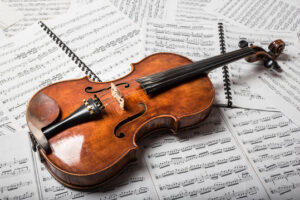
The three pieces on this program all have the unifying thread of rising above circumstances with a hopeful outlook in an otherwise grim landscape. Whether it was successful or a misguided attempt is individual to the piece!
Of the numerous perennially popular orchestral pieces, a few only received such adulation after an instrumentation reimagination. Prime examples are Mussorgsky’s Pictures at an Exhibition (originally solo piano, orchestrated by Ravel) and Blue Danube: it was originally for choir! And it was sniggered at by the audience at its 1867 premiere for its ill-timed, vacuous lyrics, given its happy-go-lucky spirit in a war-torn Vienna. Johann Strauss immediately knew it to be a flop because the audience only clapped enough for one encore, as opposed to upwards of nineteen that he normally received.
After Strauss transcribed it for orchestra a few months later, it received immediate acclaim. Now, over 150 years later, not only is it synonymous with Vienna, but it has the additional honor of being the unofficial anthem of space for being featured in the docking sequence in the 1968 film 2001: A Space Odyssey. In May of this year, the European Space Agency held a live concert of the Blue Danube with the Vienna Philharmonic to celebrate the agency’s 50th anniversary and Strauss’s 200th birthday. They subsequently transmitted a recording of the concert to Voyager 1, which is the furthest any man-made object has traveled from Earth, and joined masterworks such as Beethoven’s Fifth Symphony and Stravinsky’s Rite of Spring on the Golden Record.
Johannes Brahms had reached such intense fame as not only a prodigious pianist but as a tremendous composer that he was most unwillingly dubbed “The Next Beethoven.” In fact, when a family member of Strauss asked Brahms for his autograph, he wrote out the opening of the Blue Danube and “Unfortunately not by Johannes Brahms.” But despite some humor, such a lofty moniker made the already shy Brahms very self-conscious and reticent about his projects, even amongst friends. But of the Third Symphony, his most concise symphony, he was confident enough to willingly give his friend Antonín Dvořák a rare sneak peek. While corresponding with his own publisher, Dvořák declared:
“I say without exaggerating that this work surpasses his first two symphonies; if not, perhaps, in grandeur and powerful conception, then certainly in beauty.”
Brahms, who notoriously agonized over his compositions and dragged out the process, composed this in a surprisingly short amount of time while vacationing in Wiesbaden during the summer of 1863. This idyllic city, renowned for its thermal spas and neoclassical architecture, lies on the bank of the Rhine River, situated in a valley abutting the foothills of a minor mountain range.
As a lover of both nature and solitary walks through it, the refreshingly serene setting seems to have had a profound effect on Brahms for compositional inspiration. The symphony’s overarching theme is “free but happy” (frei aber froh), manifested as the musical pitches F- A-flat- F, and is a direct response to his friend Joseph Joachim’s dismal “free but lonely” (frei aber einsam, F- A- E). To further highlight the change from einsam to froh, the theme of the symphony actually begins on the third chord, F, as if to underscore the froh.
Of the nature inspiration, Clara Schumann said the second movement was “a pure idyll… I hear the babbling brook and the buzz of insects.” In addition to being a world-renowned pianist, Brahms also played cello and horn. Both are featured melody carriers in the lush and captivating third movement. A master of thematic development, Brahms throws in a plot twist in the finale. Having withheld the expected repetition of the second theme in the second movement, it finally makes its appearance at the beginning of the fourth movement.
In 1794, Ludwig van Beethoven met Viennese violin prodigy Franz Clement and was very taken with his playing. The two became instrumental for each other; as concertmaster of Theatre an der Wien, Clement helped arrange for the 1805 premiere of Beethoven’s Third Symphony, and Beethoven composed this violin concerto for Clement at the end of 1806. According to Beethoven’s student Carl Czerny, Beethoven only finished it two days before the premiere, leaving Clement to practically sightread. Hence the dedication’s play on words: Concerto par Clemenza pour Clement (Concerto with Clemency for Clement).
Much like Blue Danube, it’s difficult for modern music lovers to comprehend such staples experiencing negative or lukewarm premieres. For almost forty years, the concerto lay in repose until a much celebrated 1844 performance in London by 12-year-old prodigy Joseph Joachim, with Felix Mendelssohn conducting. The concerto became part of Joachim’s set repertoire, helping not only to launch the piece back onto concert stages but also to pave the way for other violinists to make it a gold standard. Fritz Kreisler further elevated the piece by composing a wonderful cadenza. The Kreisler cadenza, which Sirena Huang will be playing, has been praised for its excellent balance of technical prowess and artistry, while sounding as if it’s original to the work.
Thanks to Joachim and Kreisler, this wonderful concerto continues through the generations of new artists, of which Ms. Huang is one of the honored torchbearers. BSO violinist Jennifer Guzman was in attendance for Ms. Huang’s Carnegie Hall debut recital earlier this year. Mrs. Guzman reflected:
“Sirena Huang stands among our most celebrated and inspiring violinists–an artist of exceptional character and vision. She brings to the stage not only technical beauty and powerful artistry, but also a profound sense of connection with her audience. With poise and purpose, Sirena took the stage, captivating the audience with a stunning and brilliant performance. Her performance of the Beethoven Concerto is, without question, a must-see”.
Of Beethoven’s three distinctive style periods, the Violin Concerto is near the start of the middle period. Also nicknamed as his “heroic” period, this time was highly reflective of the changing ethos in art and literature; the pervasive theme of the artist’s outside world and inside world not aligning would have deeply resonated with Beethoven. His heroic era is defined by coming to terms with the terrible reality of a musician becoming deaf, yet resolving to triumph over it by composing some of the world’s greatest music in his remaining twenty years.
This new mindset of Beethoven’s manifested itself in several compositional style changes, which are on display in the Violin Concerto. He greatly extended the use and range of dynamics, with volume being relied on much more heavily as an expressive tool rather than simple textural contrast. Especially in the area of concertos, where the dynamics in Baroque and Classical concertos were fairly limited, this concerto has notoriously complex dynamics even to the modern player. Second, Beethoven explored new harmonic territories beyond the finite prescribed standard. In the first movement of the concerto, the rising scale switches to the parallel D minor, rather than the expected B minor. A final, yet very important, characteristic of this period was a heavier reliance on the timpani. Beethoven is credited with its increased use and helping to make its inclusion standard. The opening four repeated notes on the timpani would have been unlike anything contemporaries would have heard.
Beethoven, Brahms, and the Blue Danube takes place on November 15th at 2 & 7:30 p.m. at the King Center for the Performing Arts. More information about the concert and tickets are available here.